

Ways to ‘No’ to Stakeholders: Tech Scripts that don’t start a fight

Frankie Kemp
24 October 2026
Tech goes wrong, and people want help. They don’t get it, so they complain: first to you, then to your manager. Their problem is now yours, times two.
In this post, I described how the ACER formula smooths out a tech issue before it becomes a crisis. If part of that was response was in expressing a ‘no’, it’s rarely the ‘no’ that’s the issue but how you deliver it. Do it badly and you’re left with people problems on top of the technical ones.
I’ve written about this aspect of communication a few times, but this one is specific to tech teams and service desks.
Below are word-for-word scripts for six situations tech teams meet every week: whether it’s a straight ‘no’ or a ‘no, not now’ or ‘not this way’.
Why a flat “no” backfires
A bare ‘no’ lands is like slamming into a brick wall, giving nowhere for a frustrated individual to move. Eventually, the stakeholder escalates, and your day gets longer. Usually by a meeting, two long winded emails and a dozen Slack messages.
The fix is a structure you can use on a call, in chat or in an email. If you’ve read my ACER framework post, you’ll recognise the moves: Acknowledge, Clarify, Ease, Return. Each script below is tagged with the steps it uses.
Five rules before you open your mouth
- Acknowledge first. Show you’ve seen the request and why it matters to them.
- Give one reason. Offer a list and they’ll pick the weakest item, so express one strong rationale.
- Say which kind of ‘no’ it is. ‘Never’ and ‘not yet’ are different answers.
- Offer something. A smaller version, a later date, a different route. Only offer what you’ll actually deliver.
- Finish with a next step. A date, a name, or a time you’ll come back.
Six situations, six scripts
These are examples. Change the words until they sound like you.
1. “Could you just…?”
The situation: it’s 4pm, and someone wants a “quick” report that is not, in any known universe, quick.
Try:
“I’d like to help with that. Let me look at what it does to what I’ve got on today.”
“Here’s what’s already on my list, with the deadlines. Where would you put this?”
“Yes, I can do that, if it can wait until Thursday.”
Why it works: showing your list beats describing it. Most people will look at three urgent items and quietly go and ask someone else, and a small part of you will cheer. I cover this “show, don’t tell” move, and others, in four ways to say “I’m not doing that”.
2. It’s outside your remit
The situation: a request that belongs to another team, or sits outside the SLA.
Try:
“I can see why you need this sorted.”
“Here’s what’s inside what we cover, and here’s what sits outside it.”
“This part belongs to the networks team. I’ll introduce you and help you work out what to ask.”
Why it works: “Not my job” ends the conversation. “Here’s who does this, and I’ll help you get there” ends it with a route.
3. Access, permissions and security
The situation: someone wants admin rights, or wants a security step skipped because they’re up against a deadline.
Try:
“I get why the extra steps are a pain when you’re against the clock.”
“Admin access on shared systems puts everyone’s data at risk.” (One reason. Resist the urge to add four more.)
“What I can do today is run the task for you. And yes, I can set up temporary access, if your manager approves it.”
Why it works: the reason is short and about protection, not policy for its own sake. And there’s a way forward.
4. “No, for now”
The situation: you can’t take it on at the moment, but it might be worth doing later.
Try:
“This isn’t a no. It’s a not yet.” Do ask them to check in with you within a specific time frame. Protocols may have changed in a few months, for instance.
“We’re committed to the migration until the end of the month. We can look at your request after that, if it’s still a priority for you.”
“I’ve put it on the list for November planning, and I’ll come back to you by the 3rd.”
Why it works: they know where they stand. One note: asking the stakeholder to remind you later, which can work for non-urgent requests and tests how much they care. For anything urgent, it’s you who does the coming back..
5. They’re about to make a risky decision
The situation: a stakeholder wants to go live without testing, or approve something that will hurt on Monday morning.
Try:
“May I raise something before we decide?”
“I wouldn’t be doing my job properly if I didn’t make sure you understood the consequences.” (Leadership coach Carla Miller uses a line like this, which I wrote about in how to say ‘no’ to your managers.)
“If we go live on Friday without testing, the likeliest outcome is that payroll is down on Monday. We could delay by a week, or launch with a reduced scope. Which would you prefer?”
Why it works: asking permission to speak keeps you respectful and in the room. Stating the consequences in plain facts lets them reach the conclusion themselves. Handing back a choice means they still own the decision.
6. Pushing back on a supplier
The situation: you’re the customer this time, and the proposal doesn’t meet your needs.
Try:
“Thanks for turning this round quickly.”
“The proposal doesn’t meet our requirement for 99.9% uptime.” (Swap in your actual requirement. One reason.)
“We can move forward, if you can show how you’d meet that.”
“I’ll need your revised proposal by Friday, and I’ll give you our decision by Monday.”
Why it works: you’re firm on the requirement and open on the route, and both sides know the dates.
Note: Too many tech staff treat SLAs and existing processes as holy edicts carved on rock. Just because the policy or the SLA includes a particular constraint now, it doesn’t mean it can’t be reviewed or changed. In specific cases, exceptions can be made. Once a supplier relationship is underway, the realities of the situation may demand adapting the original agreement, and front line staff are well placed to observe and rationalise this need.
Swap this for that
Print this out or save it so you don’t accidently end up saying the wrong thing and building yourself a booby trap:
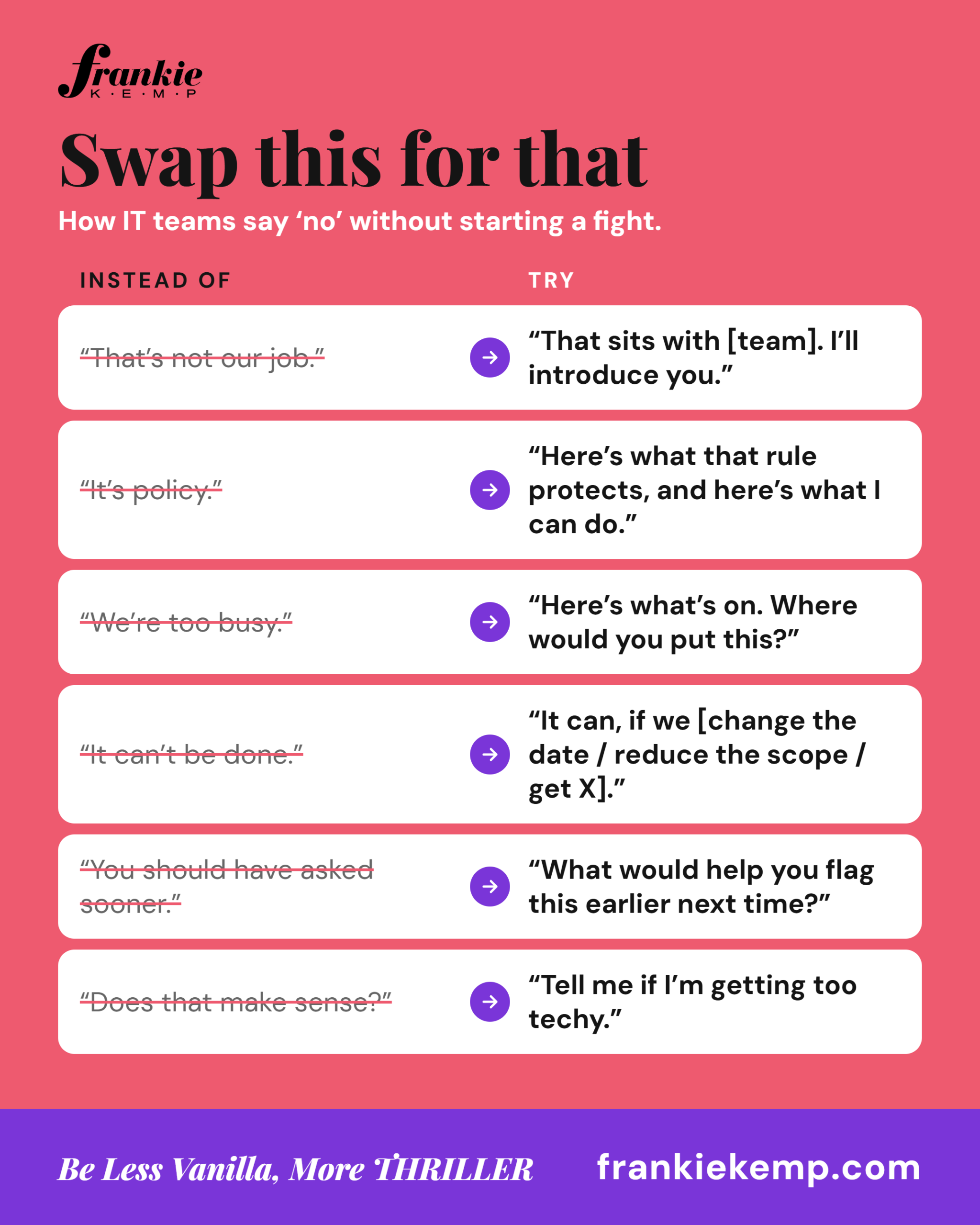
And yes, “Have you tried turning it off and on again?” is a perfectly reasonable question. Before that, ask: “What have you already tried?” in case they think you’re inferring they’re idiots.
FAQ
How do I say no to someone more senior than me?
Use the same structure, and lean harder on showing your priorities and offering choices. “Where would you like this to sit?” respects their authority while keeping your workload honest. Syncing strategies: what to do when you have a priority clash with leaders goes further.
Should I apologise when I say no?
A small “sorry” is fine. A constant one dilutes it, and starts to sound like punctuation. “I’d like to help, but tomorrow is too soon” sounds more confident than “I’m so sorry, I can’t.”
What if they push back after I’ve said ‘no’?
Repeat your one reason calmly. Don’t add new ones, because each new reason is another dart for them to throw. Then restate the alternative you can offer.
Is it ever fine to just say no?
Yes, when it’s a genuine never. Say so clearly and kindly, rather than leaving the door open for them to knock on it every month.
Does this work in email?
The order stays the same: acknowledge, give one reason, offer something, end with a date. Open with the acknowledgement, not the policy.
Your Action Steps:
- Pick one request that’s either a ‘no’ or conditional.
- Write your answer using the five rules, then say it out loud before you send it.
- If it sounds like a robot wrote it, change the words.
Want more tools like this? Join my free Tips ‘n’ Tools list and become a Communication Ninja. If you’d like your IT / Tech team trained to handle these conversations, see my communication skills training for technical teams or get in touch.
Photo by Leo_Visions on unsplash.com



Leave a Reply