

Why Smart Teams Solve The Wrong Problems

Frankie Kemp
2 November 2025
1. Rushing, Not Resolving
Too many of us rush to solve problems by coming up with solutions. I include myself here, as well as the technical specialists I train.
There you go, bulldozing your way into ‘outcome thinking’, looking at fixes.
Not that ‘outcome thinking’ is bad in itself. It can increase resourcefulness and help us become unstuck. I wrote about that here, with an additional focus in how this benefits the way we speak to ourselves.
However, when communicating solutions before examining the problem first, this will cause even more problems instead of resolving then.
This research published in the Journal of Organisational Behaviour, shows that when teams or individuals leap straight into solutions, this often leads to:
- Overlooked information;
- Poor-quality decisions;
- A lack of confidence in chosen solutions;
- Generating fewer unique ideas.
The study shows that those teams suggesting fixes upfront spend less than half the time exploring the actual problem.
This is the solution fixation trap – a cognitive shortcut where urgency overrides understanding.
The result is that there is a mounting expense of time and money in trying to fix the fix .
2. How It All Goes Wrong – In Real Life
Here’s an example illustrating the communication approach within a client’s tech team. Someone shares their FinOps issue and in a snap, streams of code and log files flood the chat.
There’s the assumption that more data equals more progress.
Leaders end up frustrated: “Hang on. What problem are we solving?” they cry as they waste valuable time trying to translate and deduce meaning from the pile.
In this Gordian knot of supposed fixes, there’s one crucial omission: an understanding of the problem.
However, the research reveals that teams who spent more time gathering and examining data before formulating alternative solutions to a complex problem ultimately performed better than other teams.
3. How To Ensure You Solve The Right Problem
Forget asking your team to “shift mindset”. That’s too vague. Instead, apply a set of specific, strategic questions that slow the scroll and sharpen the focus.
This is the practical, research-backed way to deal better problem solving.
Use These 5 Context Anchors Before Going Straight to Solutions:
- What’s the actual problem we’re trying to solve?
(Not just the symptom—what’s broken and why does it matter?)
- What’s the impact if it’s not fixed?
(Who’s affected, and how badly?)
- What’s already been tried?
(Avoid reinventing the wheel—or repeating failed fixes.)
- How urgent is this?
(Is this a fire alarm or a slow leak?)
- Who’s accountable?
(Name names—e.g., Dayann and Kira—not “everyone.”)
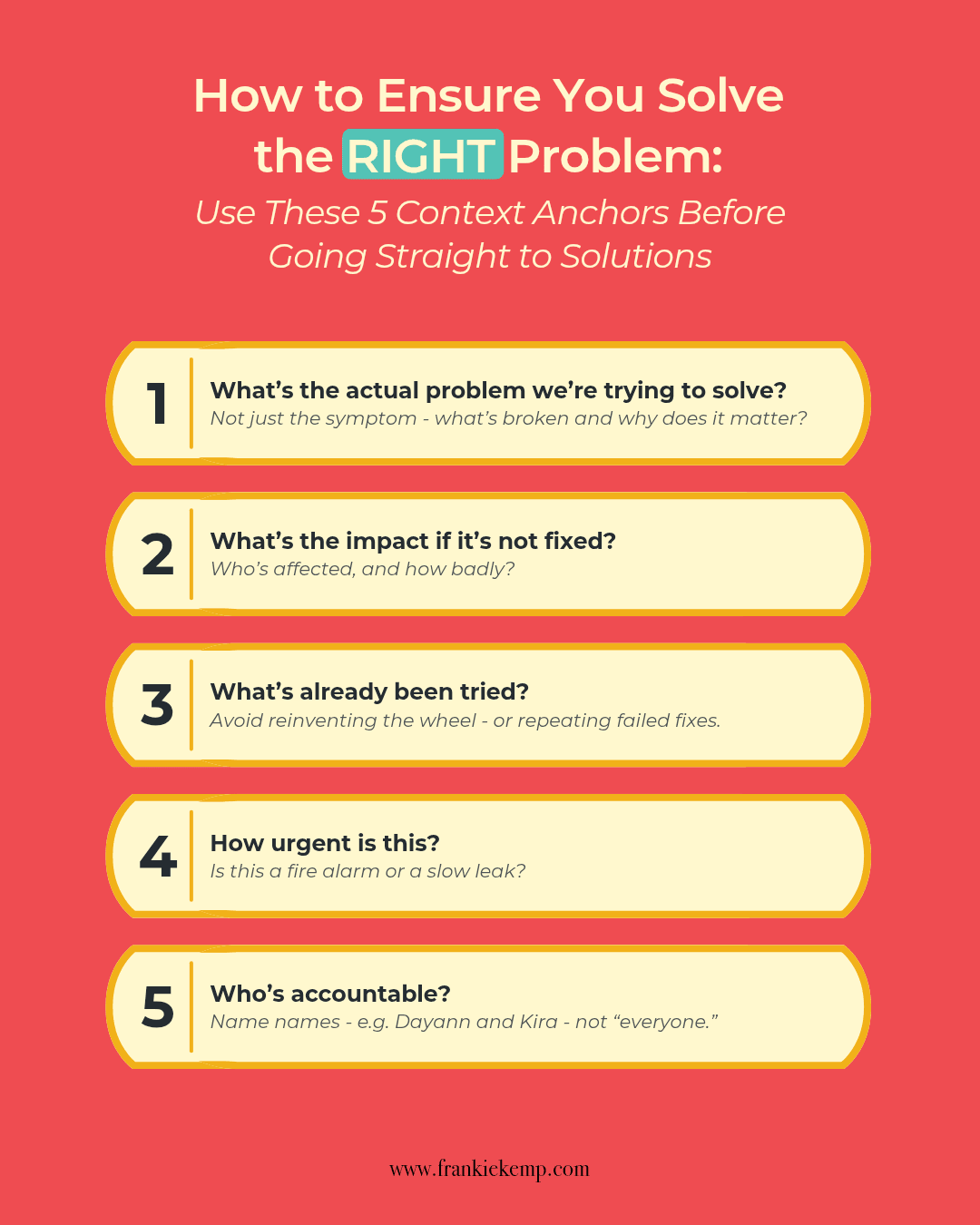
These questions act as cognitive brakes, forcing the team to frame before they fix, leading to better decisions and cleaner threads.
4. When the Data’s a Mess—and How to Fix It
| Blocker | What’s Going On | Fix (with or without AI |
| Siloed Info & Asymmetry | Key data lives in private chats, heads, or hidden tools | Use shared dashboards (Notion, Airtable); assign a “data synthesizer” to surface insights |
| Dumping Without Framing | Threads fill with logs/code before the problem is defined | Use a framing prompt: “What’s the issue, impact, urgency, and who’s leading?” |
| Incomplete or Outdated Inputs | Decisions made on stale or partial data | Use AI (ChatGPT, Claude) to summarise logs and spot gaps; rotate reviewers for context |
| Homogenous Input | Same voices, same blind spots | Invite cross-functional input; rotate who frames the issue |
| No Synthesising of the Data | Everyone posts, no one curates | Assign accountability to clarify who’s responsible for synthesis |
Your Actions:
- Someone’s put a problem in a thread? Flung it in a meeting? STOP before going into solution mode.
- Ask the questions in Section 3.
- Check where the data source.
- Slip over to Section 4 to ensure that decisions are made on complete and accurate data.
- If not, bowl it back to others to check and revert.
Want to explore how communication and influence skills training can not only help you get heard above the noise but also arrive at the right solutions quicker. Double win, right there. Become a Communication Skills Ninja. Let’s talk. Book your free 15-minute Discovery Call here.



Leave a Reply