

Psychological Reactance: Why Telling People What To Do Backfires

Frankie Kemp
13 September 2026
For MSLs, clinicians, engineers, machine-learning specialists, leadership teams and anyone working in high-stakes technical communication. Psychological reactance is why people resist a request even when they agree with the logic behind it. The instinct kicks in the moment someone feels their freedom of choice is threatened. This piece covers what reactance is, why reasoning alone doesn’t defuse it, and five practical techniques for handing autonomy back without losing authority.
In this article, I covered six reasons people resist a straightforward ask. Now for the seventh: an even more pervasive – sometimes silent – form of defiance.
You’ll see such defiance in the way someone ignores your request, dismisses an idea, or pushes back against your initiative. It’s everywhere: in the healthier diet you want a family member to follow or the way a teenager may undermine your order not to smoke; in the way your colleague nods but does nothing or the leadership team loudly pushes back.
And the fact that logic doesn’t combat reactance can leave you feeling extremely frustrated. Whether you’re trying to stop your loved one from dipping their hands into the cookie tin again or presenting a rationale for changed priorities to your Board, reasoning will often make their stance even more stubborn to shift. The problem is that some people simply don’t like being told what to do because they feel their sense of autonomy -the ability to make their own choices – has been removed.
This form of defiance doesn’t apply to everyone: there are those who appreciate the directness of a clear request. But others? That’s the moment they dig their heels in, delay the fix, or insist on doing it “their way.”
This very specific form of pushback is termed by psychologists as ‘psychological reactance’.
“What Is Psychological Reactance?”
In his 1966 study, Jack W. Brehm posited that individuals resort to psychological reactance – non-action, resistance, or outright rebellion – when they feel their freedom of choice is threatened.
A lack of choice has been the central point of many literary works. The Montague / Capulet feud in Shakespeare’s Romeo and Juliet is entirely based on love intensifying between the protagonists simply because it’s forbidden. In the fairy tale ‘Bluebeard’ – or any other ‘locked room’ fairy tale trope – you’ve a character instructed to never open a door. And you know what happens: they’ll open that damn door. Not unlike “don’t eat the apple,” back in the Garden of Eden. In contemporary culture, platform-level access removal – when a whole service such as Netflix is pulled nationally – drives up piracy searches for that exact title, more than unrestricted content does.
In the workplace, you’re dealing with a specific resistance grounded in the perception of an absence of autonomy, resulting in quiet inaction or more active, vocal push-back. It’s the reason a child finds it so tempting to touch a socket the second they’re told not to.
Such is the resistance felt when our sense of autonomy is undercut.
“Where Might I see Psychological Reactance At Work?”
Here are a few scenarios, that you’d see in more of the technical-leaning areas – the areas I see regularly in my work on leadership and team communication:
- Medical science liaisons in Pharma offering an intervention.
- Climate tech engineers needing to steer cautious clients away from a decision and towards an action.
- The COO who can’t get her CEO to accept her ideas – it’s his company “and that’s the way I want it done,” he’ll retort.
- The engineer who wants his colleague to create a simpler process for reporting changes to the wider team.
Making someone feel the idea was theirs to begin with is one way to restore autonomy. But how do you do that? Here are five autonomy-restoring techniques to help you steer the actions of others.
1. The Double-Bind Choice: Direction Disguised as Autonomy
This is the classic move: you offer two options, both leading to the outcome you want.
Instead of:
“Update the configuration.”
Use:
“We can update the configuration now or after the deployment window — whichever works for you.”
The research behind it:
Ellen Langer conducted a well-known experiment in 1975, demonstrating that even illusory choices drive compliance. Langer offered 70 office workers the chance of winning lottery tickets, with half allowed to choose their own and the other half allocated tickets. When offered the chance to sell the tickets back to researchers, the self-selectors priced their tickets at nearly eight times the amount. They clearly valued their tickets more, although they had exactly the same chance of winning as the other group.
Where you’ve seen this in action:
In a clinical setting, you might be asked which arm you’d want the needle in — rather than “Do you want me to take the blood or not?” which would completely undermine a haematology department. In tech, think how Amazon gives a choice between delivery windows, and note how little, if any, difference some of those options make.
2. The “Story About Someone Else” Technique: Influence Without Instruction
Many people hate being told what to do but love hearing what worked for someone in a similar situation. This is narrative persuasion – a behavioural science favourite.
Instead of:
“You should recalibrate the sensor.”
Use:
“I worked with a team last month who recalibrated the sensor and it solved the drift. No idea if it’ll work here, but it might be worth a shot.”
The research behind it:
Gardner and Leshner (2016) found that when diabetes self-care messages were presented in narrative format — as opposed to instructions — there was reduced resistance to the messages. This was grounded in the fact that the messages were not seen to remove freedom of choice, which reduced counterarguing and increased positive attitudes toward the messages. With less arguing back, think how much time you’d save.
Where you’ve seen this in action:
Anti-smoking campaigns often shift from “You need to quit smoking” to something like “Quit smoking so you’re around for your grandkids’ graduations.” Gyms don’t often stop at “Join. Get fitter. Look fitter.” They’ll show you before-and-after pictures of those who’ve already done so.
3. The Freedom-Restoring Disclaimer: Authority Without Authoritarianism
One person might think they sound clear and decisive, while the same words from the same person might read as bossy or domineering. This can backfire, especially in matrix teams where you may have no explicit authority over a team member. Speak to your colleagues like this and there’s a high chance of splintering the relationship, meaning they’ll be less likely to comply with future requests.
The fix:
Soften your requests to restore a sense of choice. These are also called ‘restoration postscripts’ — you hand choice back to the other person. One dependency for them to work: clarity and simplicity of the request. An abstract, complex, or multi-layered request could delay agreement to act.
Instead of:
“You need to restart the service.”
Say:
“The choice is yours. You’re free to decide for yourself.”
The research behind it:
If you’re terrified of spiders, a famous 2015 study (published in The National Library of Medicine, 2015 by Guéguen et al.) might come as a surprise. Researchers asked members of the public to hold a closed transparent box containing a live trap-door spider while the researcher popped into the post office to pick up a package. By adding “free to accept or to refuse” after the request, compliance rose from 36.7% to 53%. A related earlier study, involving some of the same researchers, found an even more marked difference with the same postscript phrase when asking strangers in the street for money: without the phrase, compliance was 10%; with it, compliance more than quadrupled to over 40%.
Other example phrases:
“Of course, the final decision is entirely up to you.”
“You are free to decide what is best for yourself.”
“I respect whatever choice you make regarding this.”
“This is entirely up to you.”
Where you’ve seen this in action:
Informed consent forms in clinical trials are built on this principle — “you are free to withdraw at any time” is standard. Email sign-ups have their own version of the softening postscript, echoing the same “…but you’re free to choose” shape: “Join our list. Unsubscribe any time.” A manager inviting their team onto a project might add, “If you decide it’s not for you, you can opt out.”
4. Hedge Your Request With Mitigating Words
There are, of course, situations where there’s no real choice — cleaning a needle before vaccination, or protecting digital information. But there are far more situations that are less non-negotiable than they first appear:
“You can switch off the anti-virus, or keep all your work and data without being pulled into a disciplinary. It’s up to you.”
See? Follow it up with the anecdote technique above for extra steerage.
But let’s say you’re speaking to a colleague and need to soften the line while still directing them toward action. How can you do this without sounding domineering?
The fix:
Use softer language — mitigating words that offer a sense of freedom of choice and relational harmony.
Instead of:
Should / have to / ought to
Use:
perhaps, possibly, maybe — as well as autonomy-restoring phrases such as “You might want to consider” or “We recommend.”
The research behind it:
Miller et al. (2007) ran a landmark study focused on anti-marijuana messaging, finding that reactance-inducing wording — language that reduced perceived autonomy — produced more anger, more counter-arguing, and less attitude change, in the very contexts it was meant to influence.
Where you’ve seen this in action:
Compliance teams sending “you might want to complete this before the deadline” instead of “you must complete this by Friday.” Helpdesk tickets that read “we recommend restarting your device” rather than “you must restart your device” — same instruction, considerably less huff.
5. Make Your People Pilots
Hand a project to a group of resistant people, tell them “I don’t know if it’ll work,” and ask for evidence either way. How they do it is up to them. Since you’re also asking for evidence, this works extremely well with the cynics who suspect another initiative for the sake of it.
I was coaching a National Director in a pharma company who was exhausted by the same pattern. Every new initiative triggered resistance: the kind that sounds like: “We don’t have the data.” “I’m not sure it’ll work.” “Can we wait until Q3?” So she made her team pilots. She’d give them the project, add the time limit, instruct them to test it, gather the data, and report back with what works or what needs to change. Six months later she told me: “It’s changed everything. No more pushback. They get on with it, own it, do it. Done.”
Here’s the underlying truth for leaders of technical specialists: when you turn people into pilots, you remove the threat. You give them autonomy and responsibility. That’s the runway before take-off but your making your team feel like they’re the pilots. And suddenly getting the most resistant person on your team to do “that thing” isn’t impossible: it’s inevitable.
The Spillover Effect: When One Restriction Threatens Others
Reactance doesn’t always stay contained to the thing you’ve actually restricted. Brehm & Brehm’s (1981) extension of the theory found that a threat to one freedom can generalise to related freedoms – the restriction spreads further than the specific rule. For example, a dieter told to give up chocolate isn’t just more likely to break the chocolate rule – they’re more likely to reject the whole diet, because the single restriction reads as a threat to their broader freedom to eat as they choose. It’s not for nothing that Weightwatcher’s allows chocolate digestives.
How to recognise it:
Objections tend to scope-creep past the specific request (“if I do this, what’s next”). The resistance may seem disproportionate. You’ve asked someone to present a report to the board, for example. In your head it’s a five-minute summary; in theirs, it’s a weekend lost to slides and a 52-page tome.
What to do about it:
Be explicit about expectations up front. For example, with meeting requests that don’t specify call duration – ask a busy leader to “chat on the phone” about something – and it’s less likely to happen. They’ll be imagining anything from 30 minutes to an hour. Don’t leave them to their own presumption: stipulate it’s only a 10-minute call if that’s what you meant, and the conversation is far more likely to happen.
Where you’ve seen this in action:
IT rolls out a single new approval step for installing software, and within a week the team’s convinced a lockdown is coming for expenses, remote work, and everything else. They’re reacting to policies that were never actually proposed. Or a patient told to cut out just one food group abandons the whole eating plan, convinced that if bread’s off the table today, everything else is next.
Mix Them Up
Layering techniques can reduce reactance even further. A 2025 study in Health Communication, focused on clinical trial recruitment videos, found that pairing phrases such as “the choice is yours” with a personal story reduced resistance further still.
How to Know if a Lack of Autonomy Is Why They’re Resisting
Even if they agree with your logic aloud, they may still slow-walk it or insist on doing it “their way,” despite yours being objectively better. The resistance can look irritated, as though they’re bristling at an instruction rather than weighing it. It tends to spike with your most senior or expert people.
In situations where you suspect reactance, watch what happens when you add a choice back in. Try an autonomy postscript at the end of the instruction: “Here’s the plan — you’re free to flag if it doesn’t work for you.”
If resistance drops the moment you reframe the same instruction, that’s reactance.
Often you won’t see the reward immediately. People might need to cogitate. Some need to save face by making it look as if they’ve decided independently, so time may pass before you hear: “I had an idea…” — an idea which was yours to begin with. Don’t remind them of that, though; it undermines their commitment to act.
If it doesn’t move, it’s one of six other reasons — and you’re solving the wrong problem by softening your language.
A Quick Guide to Uncover Motivational Blocks
There are other ways to encourage people to declare what’s actually stopping them. Tapping into peer groups can be invaluable, since individuals tend to share with colleagues what might be hidden from leaders. Even environment has a significant impact on what people share — take someone to a cafe and you may find them opening up in ways they don’t in the office. Here’s a guide to some questions that uncover those blocks and ways to build the rapport that creates conversational trust.
The Un-Feelgood Factor of Getting This Right
When you’re successful combatting reactance, you won’t get any thanks. They’re unlikely to credit you at all. And that’s because you were so good at handing the autonomy back to them: the individual sees it as their decision – not yours.
A CFO friend of mine spent two years trying to persuade a Leadership Team to change processes: so much of this was based on “you could,” “you’re free to choose” and the rest. In the end, having banged their heads against complex communication and miscommunication webs mapped on messy spreadsheets, they eventually did what she’d been suggesting for two years. No thanks. No credit.
In short, when you’ve given them their autonomy back, part of the price is that you’ll need to give them the credit for your idea.
The Core Principle
People are likelier to adopt your decision more easily when they feel it was theirs. This is what keeps reactance low and raises cooperation, whether you’re troubleshooting a model, advising a clinician, supporting a customer, or aligning a cross-functional team.
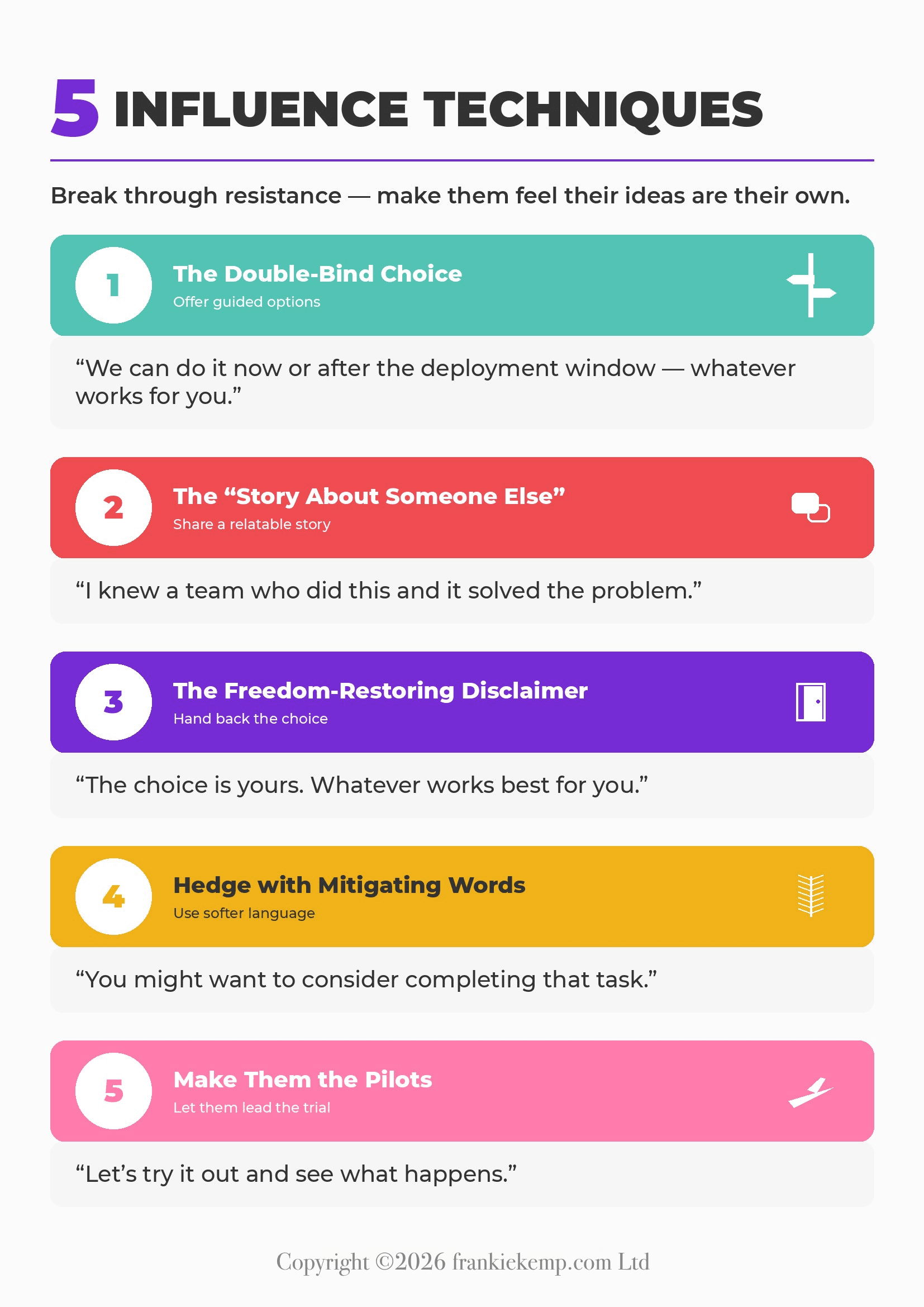
Download this for easy reference to the 5 autonomy-gifting techniques:
Your Action
- Pinpoint a situation where resistance might appear — with a colleague or a prospect, for example.
- Scan the list for ONE technique you’ll use, either in your instant messaging, face to face, or in emails.
- See what happens. Note: if it doesn’t seem to work immediately, it doesn’t mean it’s not working. They might need time before you pick your moment to use another technique.
Need some personalised support?
Feeling your dragging people along by the scruff of their necks? I offer high-level game-changing coaching and training interventions. Have a look at my influence and communication training page here . Book a free 15-minute Discovery Call here.
Not every pushback is reactance, though. If an autonomy postscript doesn’t shift the resistance, you’re likely looking at one of six other reasons — a gap in self-belief, the wrong messenger, or simply not knowing where to start. [Read: Six Reasons They Won’t Do As You Ask →]


Leave a Reply