

Signal Shifts: Non-Verbal Cues That Make Others Want to Follow

Frankie Kemp
30 November 2025
Non-verbal communication is vital when managing or leading others but is often a very much neglected area of leadership skills.
Think back to your own school days: before a teacher even spoke, you probably knew whether they’d command the room or struggle. Non-verbal signals set the tone long before words do.
When I was at school, I recall there were certain teachers who would convey such an air of unspoken authority. One particularly sticks in my mind – Doreen Hunt. Her direct eye contact, deep voice and decisive body language reigned me in. She was one of the few teachers that I respected when I was 15 years old.
On the hand, as soon as the new Maths teacher walked into the classroom, she was dinner. We’d immediately noted her raised shoulders, uncertain facial expression and shaky voice. Consequently, managing the class became extremely challenging for her.
Authority may be extrinsic, meaning it’s attributed through job title, or intrinsic, exuding through the way someone carries themselves, speaks and behaves. If it’s extrinsic but not backed up by intrinsic authority, there’s a risk of losing influence.
Researchers seeking to study the direct impact on non-verbal communication and relationships between followers and leaders decided to focus on orchestra conductors. The study found that perceivers watching only thin slices of conductors’ behaviours were able to accurately gauge their leadership success.
Your non-verbal cues carry weight. If there’s an inconsistency between what you say and how you say it, you’ll undermine your intentions.
“So what is leadership success?”
Good question if that’s what you’re asking. It’s very much in the eye of the beholder.
1. Firstly, the leader signals →
- Verbal cues (clarity, confidence, vision framing)
- Non-verbal cues (gesture, tone, presence)
- Relational signals (respect, inclusion, empathy)
2. Secondly, the follower decides whether it’s worth falling in line with the leader. This is based on follower self-concept →
- Identity alignment (“Does this leader reflect who I am/want to be?”)
- Value resonance (“Do their signals affirm my priorities?”)
- Psychological safety (“Do I feel seen and capable here?”)
Success is not an objective metric (like revenue or promotions). It’s based on how the follow views the follower self-concept elements of identity, value and psychological safety. These are constructed through the interaction. In short, one asks themselves, “Do I see myself as belonging to the tribe this leader represents?”
The Importance Of Non-Verbal Flexibility
When it comes to ‘leadership success’, effective managers and leaders aren’t locked into one non-verbal gear. They toggle their communication style. This is because they realise when to soften into warmth, when to command with gravitas, and when to reveal just enough discomfort to stay human. The magic isn’t in mastering one mode – it’s in knowing when to switch.
The compass below contains three levels of non-verbal gravitas from discomfort to authority.
Although there may be quite a few in each part of the compass, you’d only have to embody a selection to project one level. For example, someone suddenly says something you find unacceptable in a meeting: you lean back – a straight forward reverse of ‘leaning in’, seen in the ‘Friendly Cues’ section below – raising your chin slightly. A combination of a couple of non-verbals is enough to unearth the subtext.
Here are three moments that show when and how to shift between modes.
The Non-Verbal Power Compass
Often people can sound too unaffected, when they’re not. There’s a lack of awareness between what they’re sensing and what they’re conveying. Being aware of your non-verbal communication is about ensuring feeling matches expression. Here’s how to use the three different zones on the compass:
Authoritative Zone
Scenario: A team’s been spinning in circles, avoiding hard decisions.
Non-Verbal Switch: The leader drops the smile, lowers their vocal tone, and uses downward inflection with a grounded stance. Eye contact becomes brief but unflinching. There are seven ways to develop this here.
Why it works: It signals decisiveness and breaks the loop of ambiguity. The room focuses around clarity and command.
Friendly Zone
Scenario: A new hire shares an idea but looks unsure, scanning for approval.
Non-Verbal Switch: The leader softens their gaze, leans in slightly, and nods with a genuine smile. Their voice lifts with curiosity: “How do you see this working, Stella?”
Why it works: It invites contribution and builds psychological safety. Authority takes a back seat to connection. Here’s a powerful way to create the connection.
Discomfort Zone
Scenario: The leader is sharing a personal failure to model vulnerability.
Non-Verbal Switch: Shoulders slightly tense, voice momentarily shaky, gaze drops before returning.
Why it works: It humanises, conveying the discomfort that feel.
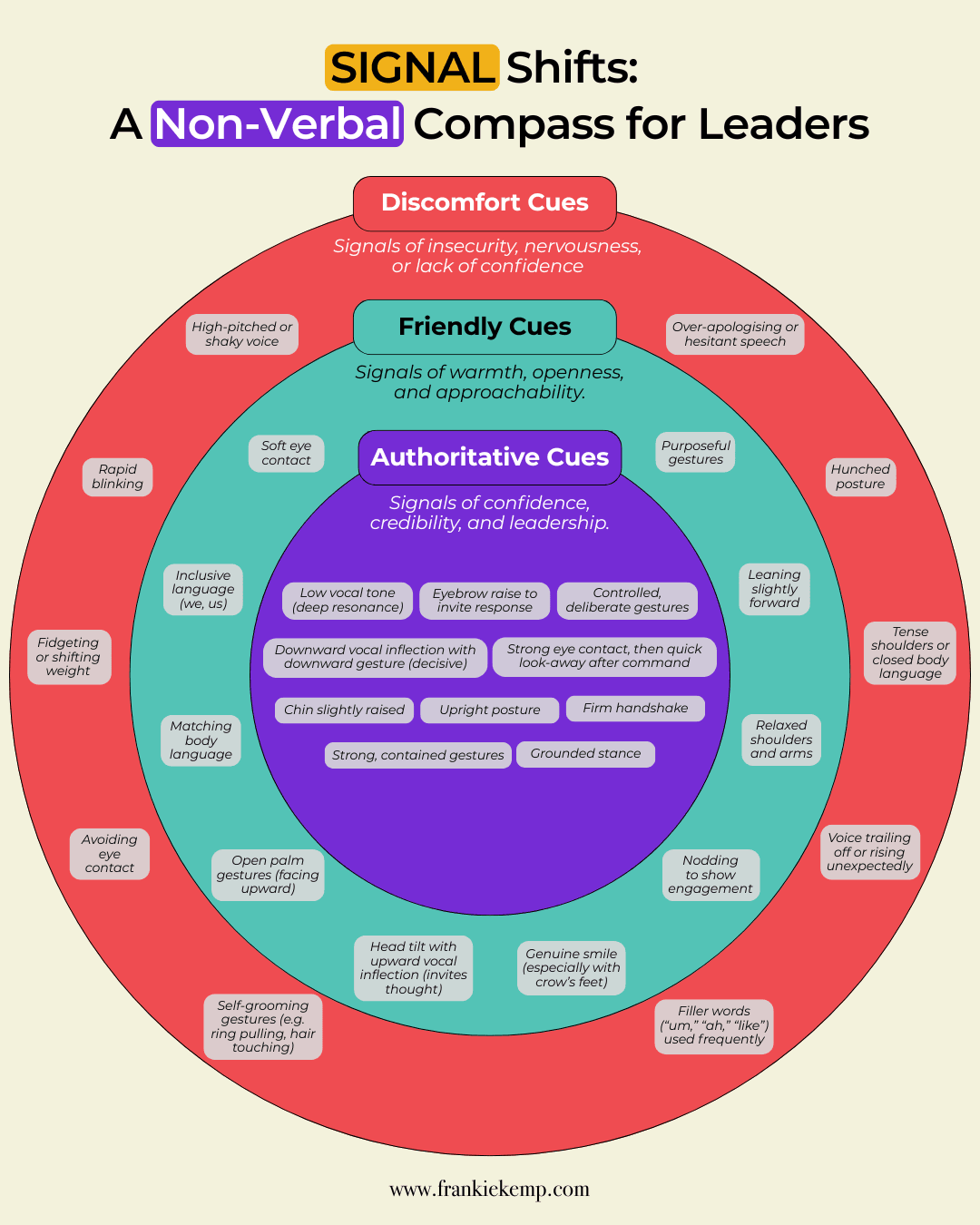
The Compass Components
Authoritative Cues – Signals of confidence, credibility, and leadership
These cues project gravitas and command respect.
- Low vocal tone (deep resonance)
- Downward vocal inflection with downward gesture (decisive)
- Strong eye contact, then quick look-away after command
- Eyebrow raise to invite response
- Chin slightly raised
- Upright posture
- Controlled, deliberate gestures
- Minimal blinking
- Firm handshake
- Strong, contained gestures
- Grounded stance
Friendly Cues – Signals of warmth, openness, and approachability
These cues build rapport and trust, ideal for collaboration and connection.
- Genuine smile (especially with crow’s feet)
- Open palm gestures (facing upward)
- Leaning slightly forward
- Matching body language
- Head tilt with upward vocal inflection (invites thought)
- Soft eye contact
- Nodding to show engagement
- Relaxed shoulders and arms
- Inclusive language (“we,” “us”)
- Purposeful gestures
Discomfort Cues – Signals of insecurity, nervousness, or lack of confidence
These cues often appear unintentionally and can undermine credibility or connection.
- Self-grooming gestures (e.g., ring pulling, hair touching)
- Filler words (“um,” “ah,” “like”) used frequently
- Avoiding eye contact
- Voice trailing off or rising unexpectedly
- Fidgeting or shifting weight
- Tense shoulders or closed body language
- Rapid blinking
- Hunched posture
- High-pitched or shaky voice
- Over-apologising or hesitant speech
Your Signals Decide What Happens Next
If you sound unsure, expect hesitation. If you look disconnected, expect silence. If you think you’re being warm but your body says “stay back,” expect distance.
Your team will pick up on the signals no matter what’s coming out of your mouth.
So whether you’re aiming for authority, friendliness, or vulnerability, make sure your non-verbal cues match the moment. You don’t have to feel it to signal it, but you do have to notice what you’re broadcasting.
Now, test it.
Your Actions Steps:
- Painful but quick: Play back a one-minute section of yourself on a video call.
- Scan for mismatch: When you watch it, are your non-verbals in the zone you intended? If not, what’s giving it away? (E.g. pulling jumper sleeves over knuckles, over-smiling, frowning while someone shares good news.) What inconsistencies do you notice?
- Channel or change: Keep in mind any behaviours you spot. Can you think of how they might be channeled or mitigated?
📝 Note: When you have self-view on during a call, you won’t pick up the behavioural nuances. Even if it’s only for 30 seconds, play back the video. You’ll spot those behaviours that glided beneath your radar in real time.
If you’re looking for help with your communication skills, have a look at what I can cover in my business communications courses. You may be seeking ways to manage up, optimise how you lead your teams or how they work together. Click here to find time in my calendar for a free 15-minute Discovery Call . No strings attached. It’s a quick call to see how I can work with you.
Photo by Jamaal Kareem at unsplash.com


Leave a Reply