

Presenting with Impact: The Four Modes That Move a Room

Frankie Kemp
17 January 2026
I once worked with a client on his presentation skills who proudly announced he was “a Red.” Not a fashion choice – though for a moment I wondered if I’d accidentally become his personal stylist – but the colour‑coding of Insights/Jungian psychology. In that system, “Red” is the dominant, decisive, directive type.
He’d been told to default to type when presenting. And because that was the energy he felt most comfortable in, he took it as permission to double down. Stay in the box. Lead with force. Keep the edge sharp.
Consequently, his team experienced him as unapproachable – even authoritarian. And the more they pulled back, the more he interpreted it as a signal to push harder.
This became a self‑reinforcing loop: “They’re distant → I must be stronger → They retreat further → I double down again.”
That’s the trap of type‑based communication. It validates your comfort zone, even when the room needs something entirely different.
Knowing your preferred communication style is useful in that it shows you where you naturally start. But staying there is where the trouble begins. When you lock into one mode, you stop meeting people where they are. You communicate from habit instead of intention. And the moment the room needs something different, you’re suddenly out of sync.
Equate this to driving. You don’t stay in the same gear but adapt during the journey.
Most of us default to a single mode when presenting or communicating: calm authority, relational warmth, contagious energy, or decisive direction.
However, flexibility is not a “nice to have” in communication. It’s the whole game.
So instead of forcing yourself to perform one fixed “type,” there’s a better approach: treat communication as a set of modes you can choose from. Not boxes. Not colours. Not destiny. Tools. Each one solves a different problem in the room. The real skill is knowing which energy to reach for in the moment.
Because once you stop clinging to a single style, you unlock something far more powerful: range. And that’s where these four presentation modes come in. They’re the cleanest way to understand the energies that actually move a room – the ones great communicators shift between with intention, not instinct.
Let’s break them open.
The Four Communication Styles To Integrate Into Your Presentations.
Most presenters default to one communication energy: but great communicators can shift.
Across thousands of talks, workshops, and pitches, four repeatable modes show up again and again:
🟦- The Sage: calm authority
🟩- The Connector: relational depth
🟨- The Enthusiast: contagious momentum
🟥- The Boss: decisive direction
The point is to be able to move intentionally into each mode, depending on the moment.
When To Shift Type
Each mode has a different function in the room. You’ll probably have your default. See if you can spot it here:
🟦 The Sage 🧠
Says: “Let’s bring some evidence and experience into the room.”
Function: Adds clarity, context, and credibility.
Subtext: “I’ve seen this before – let me show you the pattern.”
🟩The Connector 🫱🏼🫲🏿
Says:“I get you.”
Function: Regulates emotion and builds trust.
Subtext:“You’re safe, seen, and not alone.”
🟨 The Enthusiast 🔥
Says: “You’ll love this!”
Function: Generates energy and momentum.
Subtext: “This is exciting — come with me.”
🟥The Boss 💼
Says: “Here’s what we’re doing.”
Function: Cuts through noise and creates alignment.
Subtext:“I’m making the call so we can move.”
The one‑line summary version
Sage: “Here are the facts.”
Connector: “Here’s how I get you.”
Enthusiast: “Here’s the spark.”
Boss: “Here’s the call.”
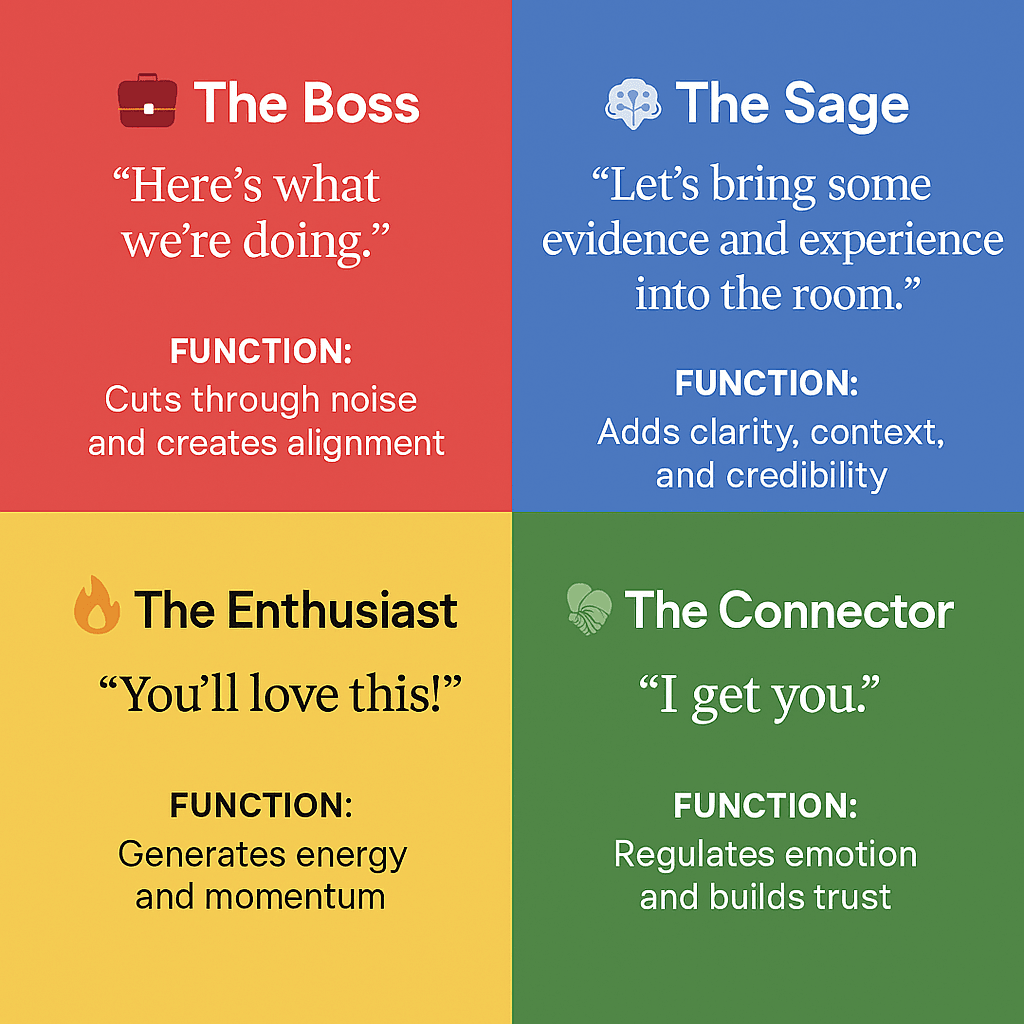
Your Action Step One:At this point, you’ll probably realise that you’ve one or two specific preferences. Which one(s) is your go-to? Now read on to see how you can extend your style. |
A Deeper Dive – And The Risks
🟦The Sage 🧠
Core vibe: Calm authority, strategic insight
Language style: Precise, layered, often process-driven and fact or evidence-led.
Use when: you’re introducing change, a new direction or a course of action to give assurance that there’s a basis for this request.
Strengths:
- Simplifies complexity – uses analogy or experience.
- Commands respect through clarity and depth
Risks:
- Can feel aloof or overly intellectual
- May default to monologue over dialogue
Example phrases:
“Here’s the principle behind this…”
“Let’s zoom out for a moment.”
“This pattern shows up across industries.”
🟩The Connector 🫱🏼🫲🏿
Core vibe: Warmth, empathy, relational depth
Language style: Inclusive, validating, emotionally intelligent, tends to use stories and open questions that invite dialogue
Use when: there’s cynicism or a sense of defensiveness in the room. Also useful for introducing solution that might initially unsettle listeners. Add warmth when there’s a challenge ahead and they want to see your empathy.
Strengths:
- Builds trust quickly, especially when showing the problem and desire from the audience’s perspective.
- Excellent at matching and labelling [for example “That sounds like”, “It must be,”] paraphrasing in-person.
- Echoes their language, even if it’s not yours.
Risks:
- May over-accommodate or dilute boundaries
- Can lose authority if not anchored with the Sage.
Example phrases:
“Sounds like you’re navigating a lot.”
“Let’s unpack that together.”
“You’re not alone in this.”
🟨 The Enthusiast 🔥
Core vibe: Energy, momentum, contagious optimism, yellow, jazz hands, sparkles
Language style: Punchy, expressive, often metaphor-rich, often declarative – making statements or asking rhetorical questions e.g. “Isn’t this..” / “Look how…”. Definitely doesn’t use the words, ‘hope’ or ‘try’. Here’s what you can use instead.
Use when: you want to add energy as the room is flagging or there’s a need to maintain energy. Great for introducing solutions and presenting a transformation linked to the audience’s motivators.
Strengths:
- Inspires action
- Makes ideas feel doable and exciting
Risks:
- Can feel scattered or ungrounded
- May skip over nuance or emotional depth
- People might view your statements as presumptive
Example phrases:
- “This is a game-changer!”
- “Do it. ” (Not “try this“)
- “Let’s make this fun and fast.”
🟥 The Boss 💼
Core vibe: Decisive authority, direction-setting, unapologetic clarity
Language style: Direct, distilled, outcome‑focused. Short sentences. Strong verbs. No hedging. No emotional cushioning unless intentional. Here’s how people might unintentionally undermine their ‘boss’ persona.
Use when: there’s a need for direction or to reset the dynamics when people are less focused.
Strengths
- Cuts through noise and accelerates decisions
- Sets standards, boundaries, and expectations with zero faff
- Creates psychological safety through clarity (“Here’s what’s happening. Here’s what’s next.”)
Risks
- Can feel blunt, domineering, or dismissive if untempered
- May shut down nuance, dissent, or emotional expression
- If overused, can create compliance instead of commitment
- Without the Sage or Connector, can come across as “my way or nothing”
Example phrases
“Here’s what we’re doing.”
“This is the standard.”
“That’s not acceptable — here’s the fix.”
“We’re moving forward.”
“This is the decision.”
Matching The Energy To The Room
None of these personae is “better.” Each solves a different communication problem.
The magic is in knowing which energy the moment needs:
🟦When the room is confused → Sage
🟩 When the room is tense → Connector
🟨When the room is flat → Enthusiast
🟥 When the room is drifting → Boss
Don’t Box Yourself In
Mastering presentations isn’t about being ‘one type’ but about being fluent: about shifting gears with intention
Remember: most of us are a blend of styles — and we shift more than we realise.
Your Action Step Two:Pick one of the types you feel you underuse when you communicate or present. Integrate it.Here’s a great visual showing how you can non-verbally switch modes |
Changing Your Tune
A while back, I went to a friend’s event about living on fermented foods. The room was full of people praising the pickled, which is more or less how I felt after the fifth presentation about how kombucha had transformed someone’s soul. The phrase that kept surfacing was “I feel…” Over and over. Very Green.
Twenty‑five years ago, I probably wouldn’t have noticed. But after years of working with research-heavy, data-driven clients – from Pharma to Software – I’ve needed to adapt. I’ve learned to speak Sage when the moment demands it.
So there I was, surrounded by jars of kimchi and kefir, silently screaming for a single data point. No evidence. No research. Just a lot of feelings about fermented cabbage. It drove me absolutely nuts.
And that’s the point: we can change. We do change. Our communication modes evolve with our environments, our audiences, and our responsibilities. The skill isn’t in clinging to one identity – it’s in choosing the right energy for the room you’re in.
Looking to connect more with your audiences? Get team public speaking training or individual presentation skills coaching that transforms you from meh to marvellous.
Hop on to a free 15-minute Discovery Call here to see if we can work together. No strings attached.



Leave a Reply