

How to begin your presentation – so that it engages right from the get-go

Frankie Kemp
8 June 2025
When most people think they’re beginning their presentation, they’re not. They’re stumbling through introductions—name, role, and maybe, if you’re lucky, a hint of the specific subject.
As for questions, you’re expected to divine whether you can ask them or not so assume you’ll be talked at or phase out. Senior Leaders will be more likely to interrupt leaving the speaker blindsided by unexpected queries.
Even more commonly omitted is the basis of a presentation: the purpose of it. This is the reason the audience should care in the first place – the ‘why’.
One of the most persistent issues with presentation skills for technical specialists is the fact that speakers are often addressing people with mixed interests, knowledge and specialisms.
The opening of the presentation provides the opportunity to gain everyone’s attention, regardless of these differences. However, most presenters let that opportunity slip through their fingers. Consequently, keeping attention becomes a struggle.
Your presentation skills depend on removing the ambiguity. Set expectations, spark interest, and give your audience a reason to engage.
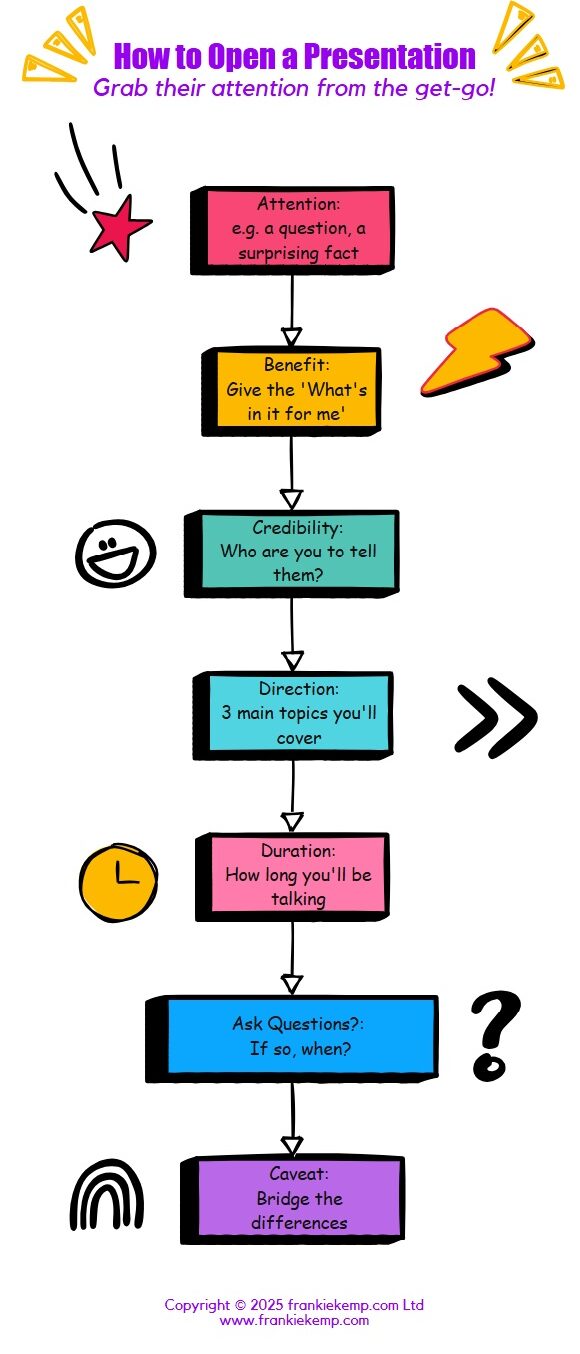
The A, B, C, D of Effective Presentation Openings
1. Attention – Capturing Your Audience Immediately
Think of this as adding ‘Spice’ to your talk. My presentation skills training emphasizes engagement techniques—distilled from a wealth of books on public speaking an I stick them on to one page, saving you massive amounts of reading and YouTube videos. The three easiest ways to grab attention:
- Ask a question
- Show a compelling visual
- Invite interaction (“Think about…”, “Stand up if…”)
For the complete list of conversational hooks for your entire presentation, go here for the downloadable Spice Rack™.
2. Benefits – Answering ‘What’s in It for Me?’ [W.I.I.F.M.]
Your audience is asking: “Why should I listen?” Tell them. Obviously, this is a convenient time to tell them what you’ll be discussing. Some of the benefits of this may include:
- Saving time or money
- Boosting efficiency
- Avoiding risks
To find your audience WIIFM, use this to help you
Note: you haven’t said who you are yet. This is because they don’t care. Tell them how they’ll gain from listening then they’ll want to know who your are.
3. Credentials – Establishing Authority Without Overkill
Who are you to tell them? A simple statement—your experience, expertise, or track record—is all you need. No need to oversell; not only should your presentation skills prove your credibility, but the examples you give and the stories you tell.
4. Direction – Providing a Roadmap
Set expectations upfront. Instead of overwhelming people with detail, outline the key sections of which there should ideally be three.
“I’ll be covering: Key factors in payment processing, How the latest tech affects compliance, Common challenges and how to navigate them”
If you don’t have this, don’t be surprised if Senior Leaders derail you with requests to cover particular points. If they know what you’re going to cover right at the start, they’re less likely to demand answers to uncovered topics.
Three Extra Must-Haves
5. Session Duration:
How long will you be speaking? Setting expectations upfront builds trust.
6. Question Rules [Rules of the Road]:
If you don’t want them to interrupt you, you need to say. If you say nothing, Senior Management in particular, are more likely to jump in whenever they like. If that’s disruptive, lay out the rules beforehand, for example:
“’I’m leaving 10 minutes for questions at the end, so if you have any make a note and I’ll answer them then.”
7. Audience Caveat
If attendees come from different backgrounds, acknowledge their varying perspectives. This will keep everyone with you rather than wondering why you’re talking about an issue that might not be relevant to them. They know you’ll get to it. A statement, such as below, will do the job:
“I know we have marketers and technical specialists here—so I’ll cover how this system impacts both sides.”
The Duration of the Opening
You’ll be relieved to know it should only last a minute or two, regardless of how long your presentation is. Like the ending of your talk, it’s a bookend – but extremely important for winning your audience over.
The Recap:
1. Attention
2. Benefits
3. Credentials
4. Direction
…and don’t forget:
5. Duration
6. Ask Questions?
7. Caveat
A.B.C.D. Plus D.A.C.
Your Action Step:
- Write down an upcoming **workshop, meeting, or presentation and note your **A.B.C.D. + D.A.C.—just a few words for each.
- Use this template to help you:
If you’re looking for make your presentations have more clarity and impact, look at my presentation skills training or take a look at my public speaking courses. Be less vanilla and more THRILLER.
Get in touch with me here for a free 15-minute Discovery Call.



Leave a Reply