

Analogies – A Tiny Engine For Deep Understanding

Frankie Kemp
4 October 2025
Einstein said, “If you can’t explain it to a 6-year-old, you don’t understand it yourself.” Analogies serve this purpose brilliantly by simplifying concepts in a way that land with both those familiar with them as well as those who aren’t.
In communication training and coaching with a client in Pharma about boring Teams calls, she talked about the value of an analogy.
With a Ph.D in Immunology, it’s not like she didn’t understand clinical concepts. It was more that using analogies helps memory and persuasiveness. After all, with back to back meetings and research papers raining down on her, retaining the information is a challenge in virtual ‘fact attacks’.
Ideas need to be stapled to something familiar, preferably visual and completely relatable.
For those of you standing on the edges, wondering whether it may be a little daring to add something to stats and facts, here are all the benefits of using analogies when you communicate: in presentations, meetings – in person and virtually.
Why You Need Analogies (Even If You’re A Technical Expert)
- They make the intangible concrete
Talking about the national budget deficit might seem to large or fuzzy a concept but if you relate it to household outgoings and incomings, it will be easier to grasp.
- Memory retention is improved through relating new concepts to familiar ones
For instance, relating the human brain’s memory process to a computer’s RAM – short term memory – to the hard drive – long term memory, makes the idea more relateable.
- Make communication more persuasive
Wrapping up complexity with a striking visual image can drive an idea home more effectively. For example, you’re in a board meeting where they’re trying to fix a strategy that’s completely misplaced. You argue that it’s like putting fancy solar panels on a house that’s sinking.
- Even specialists love the analogy
They too need to be able to explain concepts to others who find them incomprehensible. Don’t be surprised when you see your analogy resurfacing elsewhere. Maybe copyright it to earn a few pennies? Probably not. But gain the feelgood factor in the knowledge that you’re the inspiration.
- Understanding is the Crystal Prism
I’ll unpack this point. Even expert audiences value analogies – not because they don’t understand the mechanics, but because analogies reveal the why in a way they may not have considered. Think of it as turning a concept in the light to catch a new glint.
Take VPNs, for example. You’re not explaining the tech specs. You’re reframing the risk. So you describe the rationale behind the VPN as follows:
Compare it to passing an unsealed envelope through a city revealing all the contents of your letter, name, address and a map showing where the sender and recipient live. Next, visualise same letter in a locked box, sent by an underground secret tunnel. Your data is sent hidden from prying eyes.
That’s the difference a VPN makes: invisibility as well as incryption. You’ll not only securing data; you’re protecting identity, intention, and trust. Using an analogy in this way.
Using analogies in this way both clarify and reprioritise concepts.
Now that we’ve covered reasons for you to use analogies when communicating, you might still be standing on the edge pondering how to make one. That’s coming next week and I’ll put the link here.
Until then, here’s something you can do while you’re waiting in the supermarket queue, with more detail right here.
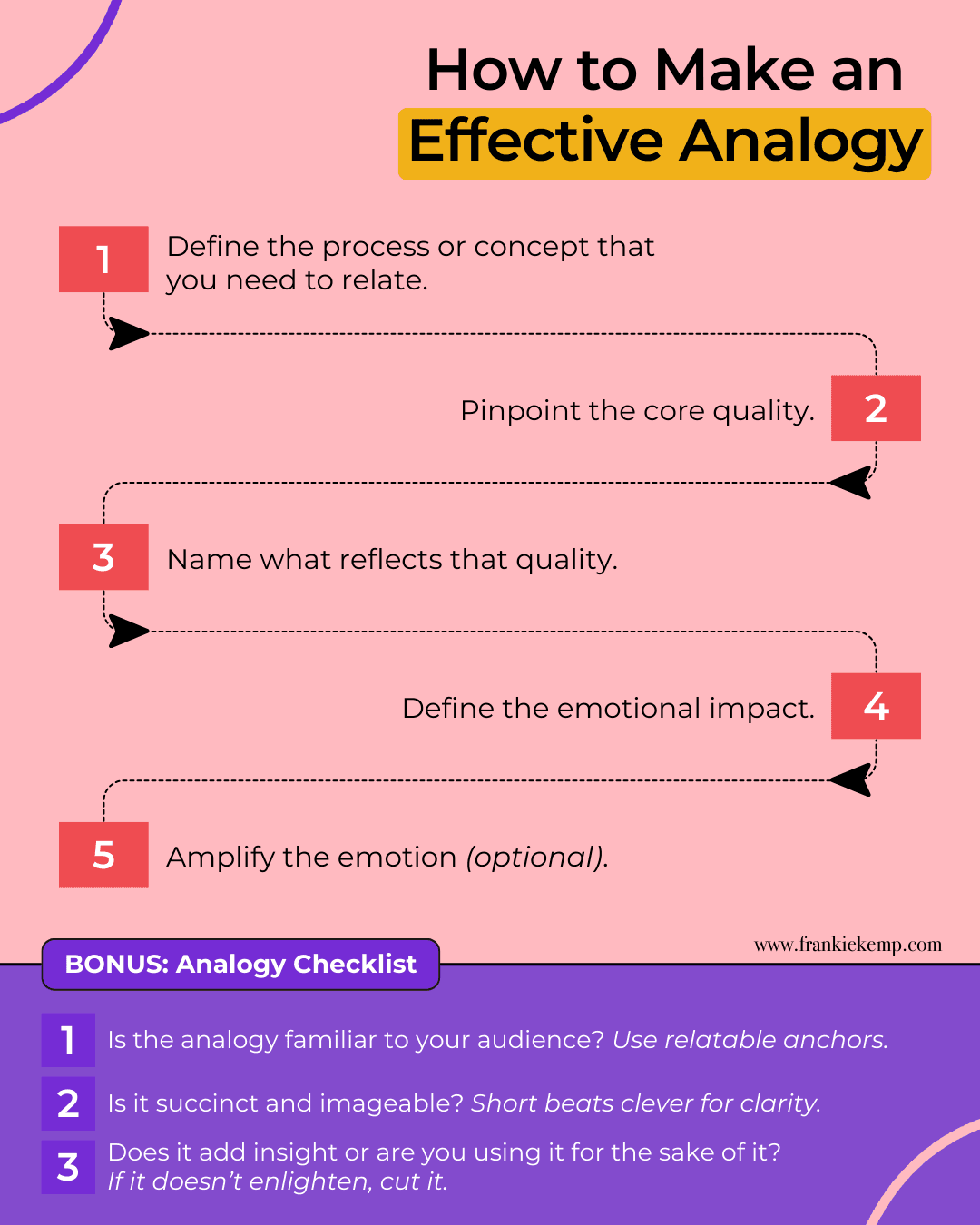
Your Action Step
- Consider a process that you think needs simplifying.
Need more support with your communication skills? Have a look here at how I coach and train teams as well as individuals to help them become less vanilla and more THRILLER, in a variety of situations from daily interactions to that keynote presentation.
Get in touch with me here and book a free 15-minute Discovery Call.
Picture by David Clode on unsplash.com



Leave a Reply