

How to Master the Three-Minute Pitch and Avoid its Pitfalls

Frankie Kemp
14 June 2026
Three minutes.
That’s what stands between you and the money, the contract, the green light…or the polite brush-off.
Investors often don’t give a crap about your proprietary technology and you can talk to your blue in the face about features.
That won’t get you the money.
When I was approached to run a pitch workshop for Ukrainian tech start-ups in preparation for their three-minute pitches for London Tech Week, I was told to concentrate on their performance, not the content. But the two don’t work separately from each other.
Rambling content that loses your audience will have a direct and observable effect on your voice, your body language and your nervous system. The way you structure your message isn’t a nice-to-have – it’s integral to the success of a pitch.
For many people this feels like alchemy. It isn’t. It’s a framework that turns ‘thanks but no thanks’ into ‘yes, we’ll invest’.
One participant walked back to his seat after his pitch and had an investor tap him on the shoulder. Then a LinkedIn message: ‘You are one of only 3 I am contacting.’ Here’s the structure that made that happen.
Nailing your Communication Skills to Make the Right First Impression
The investors that I work with bemoan the fact that tech innovators often neglect this vital area of their communication skills: they don’t look or sound the part. Hence they lose opportunities for funding.
A study by Blankespoor, Hendricks and Miller, published in the Journal of Accounting Research, found that investors form impressions of a CEO’s trustworthiness and competence in as little as 30 seconds, based on tone of voice, pace of speech, body language and posture.
However, the problem with concentrating only on body language, voice and nerves in isolation from content is true of all presentation skills training, including pitching: the content inhibits the delivery.
The Two Most Common Issues With Three-Minute Pitches
Even with a decent structure, most pitchers dwell on the wrong things: the tech, the team CVs, the features. None of that moves the dial for an investor in three minutes.
And when slides are rammed with information, the audience splits their attention between reading and listening. They end up doing neither properly.
How to Create a Successful Three-Minute Pitch
As with all public speaking, the order of the information has an impact on your ability to influence others. Here’s the structure to follow for your three-minute pitch.
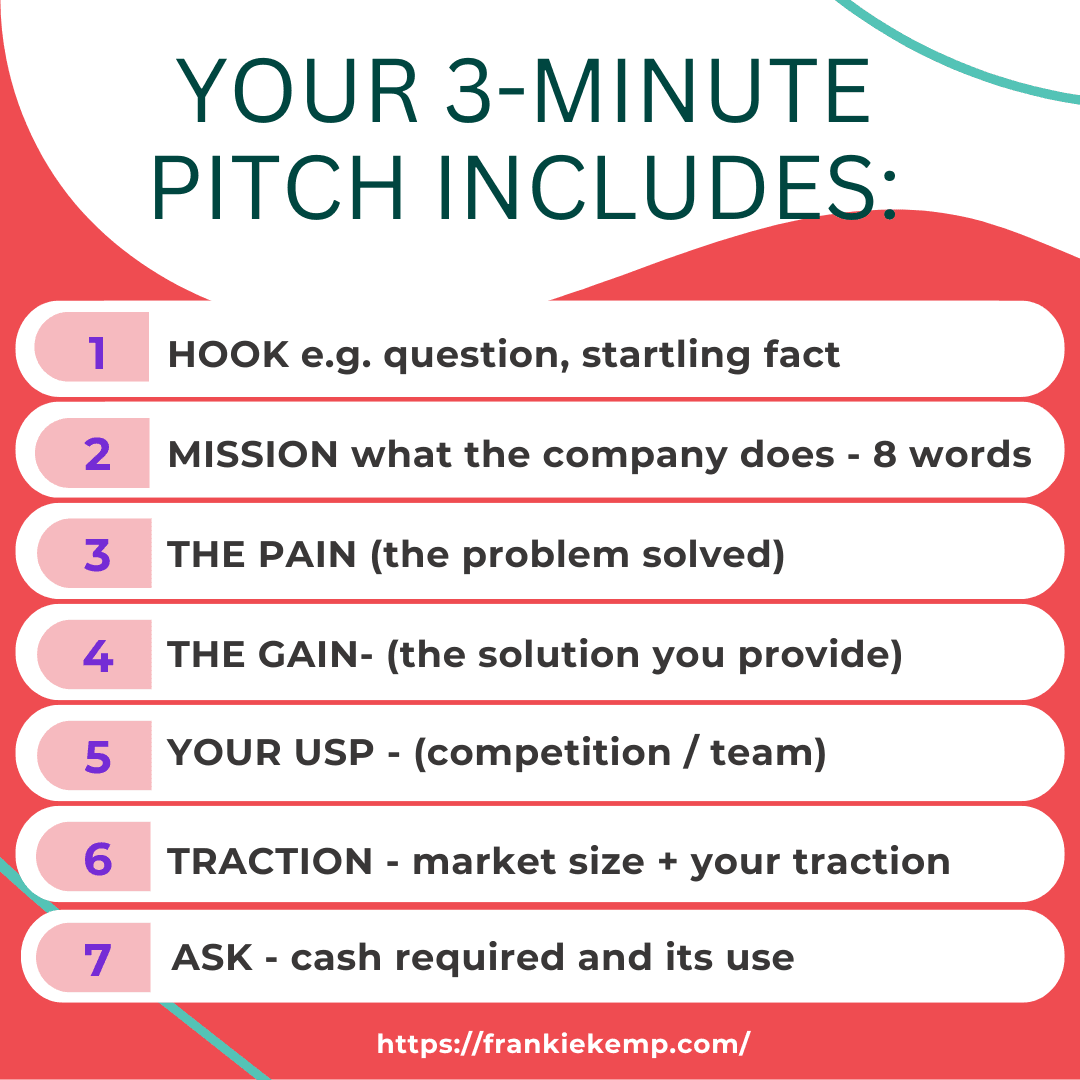
1. Start with a hook:
A good presentation will grab attention with a question or a startling fact.
2. Mission:
Tell your listeners what the company does. Use no more than eight words and it should include a benefit.
Mine, for example is: “frankiekemp.com – people skills for geeks. Be less vanilla and more thriller.”
Nike’s is ‘just do it’ If I were Ms Nike at a pitch, I’d add, “Just Do It – Empower Every Athlete in the World.”
Let’s say you have an automation for HR. That might be: “HR Harmony: cutting the everyday to grow SMEs”.
Do you see how each example includes your target audience?
3. The Pain:
Most people tend to avoid this. Investors want to hear the problem you’re solving. Don’t only give data but add an anecdotal issue such as HR processes that take too long and keep businesses from looking at initiatives to keep talent. You need to balance the situation with the stats. Your audience might instantly start relating this issue to people they know, making the challenge personally relevant to them.
4. The Gain:
Describe the pay off. Again, avoid allowing the stats to speak for themselves or describing the tech. This is where speakers start relying on ‘features speak’. For example, when stating that a car runs ‘Automatic Climate Control’, they talk about the technical features that allows this to happen. Instead of relying on the engineering innovations, aim for the benefits. In this case, these benefits would include being able to keep the temperature of the car at the optimum temperature, no matter what the weather’s doing: it’s set and forget for a comfortable journey.
Likewise, skipping the features of the tech in the HR example above, you’d focus on automating processes such as recruitment and interview tracking allowing HR to concentrate on keeping talent and upskilling the workforce so they can keep pace with strategic goals.
You’re not pitching to the product team. You’re pitching to people who invest in tech but don’t necessarily understand it, or ever want to.
5. Your USP:
This is where you describe your unique selling point against your competitors. Regarding competition, you’ll see in this table the first product ticks all the boxes. I’ve stuck a white bar over the company names at the top.
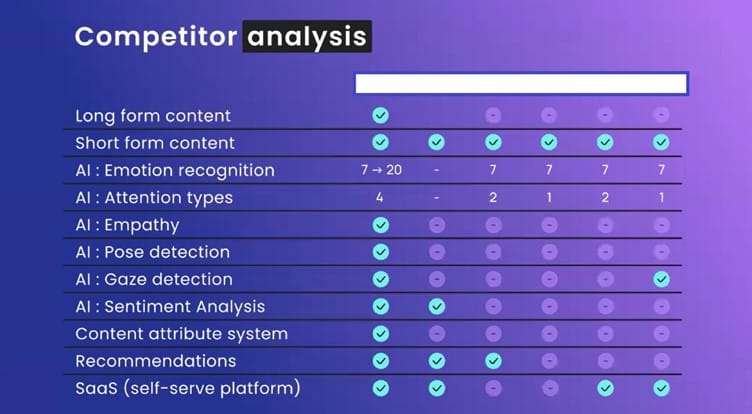
The points to mention are the aspects no-one else has, such as ‘AI: Empathy’. In three-minutes you don’t have time for much else. Regarding your team, it’s not enough to say that Jackie Marlon is our Product Team lead with 6 years’ experience. What you want to point out is that Jackie was part of the Product Team behind some hyper-successful app, or that Jackie is an ex-Google Product warrior. Again, with only 3 minutes, you’ll only have time to point out the credibility of one or two members of your team. It’s a quick guide as to the level of competence behind your innovation. In a 5-minute pitch, you’d be expected to go deeper but not here, so be selective.
6. Traction:
Here you describe how much space there is in the market. THEN, describe your traction. That way they can see how much of a hunger there is for your product or service and the potential for growth. That’s the data and stats bit. The trick is not to cram too much on your slides, as nearly everyone else does. Better to have more slides with less on each one than have too many figures and graphs crowding out one. Separation makes your points easier to digest.
7. Ask:
Now you say how much money you’d need and where you’d use it. Resist the detail. That’s for your next meeting with interested parties. Keep to a statement such as ‘Product Development to integrate VR’ or ‘Marketing’.
Don’t Fizzle Out – End With Impact
To add extra impact to your closing, you can reword the eight word pitch you mention in no. 2, without having to keep strictly to eight words.
For example, plucking from the HR example above, the 8 words pitch was:
“HR Harmony: cutting the everyday to grow SMEs”.
You could end by rephrasing this as follows:
“We cut out the routine tasks for small business so that they can concentrate on standing out, not catching up.”
Sometimes, an organisation will say you’ve three minutes and then slash it by 20 seconds just before you go on. If you run out of time, ditch this bit.
Back to the Ukrainian-UK start-up venture, I did focus on the content as well as the delivery. There were several success stories from the group of six, after their three-minute spotlight. Here’s what one of the participants said:
“The pitch training was very useful: telling the story, eye contact, emphasis, how to stand, gestures – I remembered all of this! Normally, I am quite sceptical about pitches but as I sat back at my place after my pitch, I had a tap on the shoulder. An investor commented that they liked my story and wanted to follow up. And then I also had a LinkedIn message from a prospective lead saying, “You are one of only 3 I am contacting, I want to see a demo…” So it was worth it!”
It pays to focus on what you’re going to say, as well as how you say it. Print this out, for easy reference:
Other pitch and public speaking structures
You’ll also need to adapt your pitch depending on the circumstances. Discover what you need to change and how in this cheat sheet below.
Pitching Internally
Internally, focusing on presentation skills to cover other situations such as selling ideas upwards, motivating and informing is essential. For this there are different structures you’ll need. Get them here.
The Three Non-Verbal Communication Skills That Won A Deal.
Your Action
- Ensure you’ve stuck to the outline.
- Time yourself
- Focus on the delivery with a friend or business partner.
- Record yourself. Watch it back without sound first – your body will tell you everything.
Want The Action to Gain Traction?
Here’s what happened when people worked with me:
“Pitching for funding was a trial — but after the session with Frankie, I won £5 million in contractual funding, and a £10 million grant in the one after. It’s been a game changer, significantly transforming how I present, pitch and come across in meetings.”
Normandie Wragg, Charity CEO“I was approached by TWO investors after the pitch. The training was worth it!”
Bogdan Shkarupa, CEO & Co-Founder, NeuCurrent
Got A Pitch To Work On?
If you’re pitching to investors, clients or accelerator panels and it’s not landing the way it should, let’s fix that. I work with founders at startup rates that aren’t on my pricing page (because they’re just for people like you). One session can be enough to give your pitch the punch it needs. Book a free 15-minute call and let’s see what we’re working with.
If you’re pitching internally for budget, headcount, a promotion or a project green light and the right people still aren’t saying yes, that’s a communication problem that’s also a very fixable one. Book that free 15-minute Discovery Call here.



Leave a Reply